OBJECTIVE THINKING IN VISUAL ARTS

● HISTORICAL THEORIES
In its current state, historical, critical, and pedagogical discourse in the visual arts is largely subjective and empirical in nature. Although certain concepts originate in scientific domains—such as Newton’s color theory, the trichromatic theory of vision, or studies of optical illusions based on Gestalt theories—when partially incorporated into art theory–, have not been systematized within a coherent framework of compositional analysis and often remain without direct conceptual and lucrative impact. Considering this context, what we call “composition”—understood in the present research as the organization of structure under implied-motion effects— remains, in many treatises and manuals, insufficiently grounded in a coherent theoretical framework. The lack of an explicit articulation between formal descriptions, perceptual mechanisms, and the relational structure of the image leads to partial formulations that are difficult to verify and use within a rigorous research framework. Despite this, over the course of the last few centuries, the evolution of artistic theory reveals a tendency to move from a predominantly expressive-affective approach, characteristic of subjective thinking, toward approaches that prepare the objectification of compositional analysis, specific to objective thinking.
In 19th century, for Eugene Delacroix, the notions of expression, expressiveness and expressing are used predominantly within an affective and literary register. A significant part of his works of art, like “The Barque of Dante”, ”The Chios massacre”, ”The Death of Sardanapalus”, is inspired from literary sources, like ”The Divine Comedy” of Dante Aligheri, ”The Giaour” and ”Sardanapalus” of Lord Byron, reflecting his interest for the relation between image and narration. According to romantic sensitivity the expression is associated with the narrative and emotional content of the image, and also to the analogies between the visual arts and literature or theatre. In ”Journal”, Delacroix uses these notions in various contexts, including both the affective expression of chromatic relations (Delacroix 1948, 251, 527, 539, 714) and the sizing of surfaces (Delacroix 1948, 283, 313, 373, 375, 376, 586), as well as the figurative expression of characters (Delacroix 1948, 69, 82, 158, 174, 175, 255, 257, 282, 376, 384, 441, 461, 489, 492, 540, 563, 595, 620). These observations are not organized into an explicit structural system. They remain integrated within a predominantly intuitive view of artistic visual effect. For Delacroix, compositional coherence is manifested through a form of figurative objectification, in which the stability of the image is sustained by the expressive-structural articulation of representation, without an explanation of the underlying structural relations. Furthermore, Delacroix’s view of pictorial creation is markedly subjective, as it reflects the will of the author, as indicated by his ”Journal” entry of 20 October 1853:
«[...] the painter is far more the master of that which he wants to express than is the poet or the musician, who is in the hands of interpreters; [...] but in the end it is always the same, it remains as the artist wanted it to be, whereas the same is not true of things that must pass through the hands of interpreters, as must the works of the theatre.» (Delacroix 1948, 337)
At the beginning of the twentieth century, Henri Matisse assigns to the notions of expression, expressiveness, and expressing a meaning oriented toward the structural relations of composition. Expression is no longer connected primarily to narrative or affective content. Instead, it follows the structural synthesis of the relation between color and its distribution across the surface, theoretically referred to as quantity (Matisse 1978, 35-36, 59, 70, 136, 137, 145). In this perspective, the unity of the work of art results from a compositional balance arising from the rhythmic alternation of these properties, manifested at the level of the entire compositional organization (Matisse 1978, 38). The balance is not defined by explicit rules. Rather, it manifests itself through an intuitive stabilization of the relations between positive and negative spaces, between chromatic intensities, and between their spatial distributions across the plane of the image (Matisse 1978, 37). In his conception, this position indicates a form of synthetic objectification of an intuitive nature, in which structural relations are used and recognized as operative principles of pictorial means, without being integrated into an explicit conceptual system. Matisse marks the transition from a subjective and emotive conception, dependent on the artist’s affects and will, to an empirical one, based on observation and structural organization, independent of the model’s appearance. It is therefore not surprising that he offers two distinct definitions of composition:
«Composition is the art of arranging in a decorative manner the diverse elements at the painter's command to express his feelings.»
and:
«Composition, the aim of which should be expression, is modified according to the surface to be covered.» (Matisse 1978, 36)
In the first half of the twentieth century, Wassily Kandinsky proposes an association between the notion of expression and that of number, resulting in the term “numerical expression” (Kandinsky 1947, 92; Kandinsky 1946, 90), indicating an intention to resolve the theory of composition through a modality of algebraic formalization. In ”Point and Line to Plane”, he affirms that any force can gain its expression through number, suggesting the possibility of a systematic description of plastic elements.
«In the final analysis, every force finds expression in number; this is called numerical expression. [...]Only after the conquest of numerical expression will an exact theory of composition (at the beginning of which we now stand) be completely realized. » (Kandinsky 1947, 92; italics added)
In this perspective, the plastic elements are understood as traces of lucrative actions, shaped by the tension of the gesture and susceptible to reinterpretation through concepts such as force, direction, and intensity (Kandinsky 1946, 57). This approach represents an attempt at the conceptual objectification of plastic language, through reference to physicalist types of models. Despite this, the proposed formalization operates primarily at the elementary level and concerns local relations between them, without leading to a systematic integration of relations at the level of the entire compositional context.
As a consequence, although it introduces relevant concepts for the structural description, Kandinsky’s theory remains partial in explaining the global organization of compositional structure. This limitation reveals the need for an analytical context capable of describing not only the properties of elements, but also the organizing structural relations between them in geometrical and topological terms, oriented toward continuity, separation, and overall morphological coherence.
In conclusion, we can observe a gradual increase in the objectivity of historical structural theories of composition, unfortunately not supported by an explicit and unified methodological framework. In the absence of such a framework, the operations of analysis and the conditions for validating the results remain partial, speculative, and incomplete. In this sense, Piet Mondrian emphasizes that plastic expression does not derive from the particular vision of the viewer, but from the structural relations among the components of the composition:
«In order to understand what plastic expression in art means, it is important to observe that the particular forms that reality manifests have an expression proper to them and independent of us. [...]
It is essential to observe that elementary forms and colors in their proper and mutual relationship and not our particular vision of them create the appearance of the different manifestations, the plastic manifestation of palpable reality.» (Mondrian 1986, 387)
Although the plastic experience inevitably belongs to the subjective domain, compositional structure cannot be reduced to it. It demands a relational description capable of overcoming the level of individual speculation and establishing verifiable and intersubjective criteria of analysis.
_ _ _ _ _ _ _
Sixteen years ago, I discovered, through documentaries and interviews on YouTube, the reflections on the musical phenomenon of the Romanian conductor Sergiu Celibidache. This encounter oriented me toward the study of phenomenology, particularly because I became interested in the method of phenomenological reduction as a possible framework for researching the achievement of structural unity in works of visual art. I intuited that, by following this direction, my project of compositional research, initiated during my high school years, could be theoretically grounded. This was a first catalytic moment, alongside the principles of composition taught by my professor, Neagu Vasile, and the recent discovery, in the specialized literature, of the implicit motion effect associated with cortical area V5, which contributed to the gradual emergence of my current research direction.
While rewatching the film ”You Don't Do Anything, You Let It Evolve” (Schmidt-Garre 1992), I identified three philosophical directions that shape Sergiu Celibidache’s discourse. They provide the basis for the unequivocal role of consciousness in making decisions regarding directorial and musical execution.
1) ZEN EXTREM-ORIENTAL THINKING
Celibidache’s affirmation that:
«There’s no definition for music.» (Schmidt-Garre 1992, 00:06:23–00:07:02; English subtitles)
marks the aporetic limits of objective thinking in the musical domain, emphasizing the impossibility of defining or objectifying musical experience. They suspend the dominance of rigid conceptual constraints, encouraging the emergence of creative spontaneity, without being predominantly determined by memory and representation. This facilitates musical experience as a direct response to unfolding sonic relations of executed musical compositions.
2) CARTESIAN RATIONALISM AND PHENOMENOLOGICAL SUSPENSION
Celibidache asserts that:
«Rehearsal is the sum of uncountable noes.» (Schmidt-Garre 1992, 00:22:58–00:23:21; English subtitles)
The formulation indicates a process of progressively eliminating non-conforming variants in the development of the musical act. This logic can be placed in an analogical, but not identical, relationship with Descartes’ methodical doubt and Husserl’s phenomenological reduction (Husserl 1989, §§31–33), since both imply the systematic suspension of the uncritical acceptance of convictions and, respectively, of the natural attitude. However, the purpose of these procedures differs: for Descartes, methodical doubt leads to the identification of an apodictic certainty—the ”cogito” (Descartes 1990, M I; Descartes 1990, M II)— whereas for Husserl, the reduction discloses the phenomenon in its modes of givenness and within its intentional correlations (Husserl 1989, §§24–27). At Celibidache, it can be understood as working method in musical rehearsal, involving the progressive organization of the musical material. In this sense, the Cartesian doubt and the phenomenological suspension can be understood as processes of methodological negation predating the constitution of a system of certainties, without being confounded with the theological apophatism (Coward & Foshay 1992), as I did in EXPO 2 METAPHISICS.
3) THE PHENOMENOLOGICAL REDUCTION
In response to the maestro’s question:
«When I’m able to reduce?»,
One of the advanced students responds:
«When there are interrelations between the single parts.» (Schmidt-Garre 1992, 00:52:10–00:53:54; English subtitles)
This affirmation does not concern the term “reduction” in a transcendental or strictly Husserlian sense, but indicates a structural condition for understanding the musical phenomenon: the fact that the sense reveals itself only within the relations between its parts. In this way, “reduction” can be understood as a means of access to the inner relational coherence of an already relationally structured phenomenon. In an analogical sense, this perspective is closer to Husserl’s eidetic reduction, insofar as both seek to identify certain invariant structures by going beyond the immediately given, although, in Celibidache’s case, these structures manifest themselves as relations in the development of musical execution, whereas for Husserl they are essential structures of experience (Husserl 1960, §34).
The review of these basic philosophical reference points in Sergiu Celibidache’s conducting activity reveals his predominantly practical conception of musical experience (Zelle 1996). Their purpose is to facilitate a direct musical experience, grounded in the decisions of consciousness and in the immediate experience of sound. Considering this, we can affirm that the structural research method of visual works of art presented in this exposition follows a different pathway. Its goal is not to facilitate a direct artistic visual-compositional experience, but rather to methodologically code – through objectification – the compositional structure belonging to the image of the researched work of art. From this perspective, the researcher’s activity can be more closely linked to the development of a score by a musical composer than to the execution of a musical work.
Furthermore, of the three directions identified in Celibidache’s discourse, only the phenomenological orientation can serve as a reference point for the conceptualization of our research. The method of eidetic, or essentializing, reduction can be identified in the second stage of the research, while phenomenological suspension provides an analogous point of reference specific to the initiation of each stage of the structural research.
● FROM EMPIRICAL THINKING TO OBJECTIVE THINKING
We have observed how visual artists from the mid-nineteenth century and the first part of the twentieth century continued to refer, in the structural conceptualization of their works, to the notions of expression, expressiveness, and expressing, characteristic of subjective and aesthetic thinking (Croce 1956). By subjective thinking, I mean a mode of organizing experience in which the structure of a work of visual art is primarily related to the subject (author or viewer), a notion reflected in the opposition between subjective construction and objective knowledge analyzed by Mircea Flonta, but used here in a broader methodological sense (Flonta 2024, 11, 59). Nevertheless, over time, artists tend toward increasingly objective structural solutions—that is, solutions independent of the author. However, their research is conducted predominantly within the register of empirical thinking, situated midway between subjective and objective thinking (Mondrian 1986; 176). It is based on observation – both external and purely structural – still dependent on the author’s direct decisions. For this reason, the coding of compositional structure requires an additional effort, namely the transition from empirical thinking to objective thinking (Daston and Galison 2007, 4). It does not entail abandoning observation or the results of perceptual-cognitive experiments, but rather integrating them into a conceptual framework capable of providing a methodological account of how the research object is constituted.
The transition from empirical thinking to objective thinking requires relating the methodological concepts of the research, by analogy, to the main philosophical directions of objective thinking: ontology, transcendental philosophy, and phenomenology (de Boer 2020, chap. 3; Apostolescu and Serban 2020, 23-40). These doctrines are not used as explanatory models of the method, but as conceptual reference points for clarifying fundamental methodological notions such as experience, givenness, uniqueness, objectification, and relationality. From this perspective, the objective approach to the stages of the research goes beyond the framework of phenomenology and integrates, through methodological analogy, contributions from ontology, transcendental philosophy, inferential logic, Gestalt theory, and general topology. Their role is to provide a conceptual language capable of rigorously describing the methodological processes presented below.
As we have seen in the preceding sections, empirical thinking involves correlating systematic observation of the image with the cognitive-visual principles of hierarchical processing of visual information at the cortical level, which provide the basis for the development and instrumental application of structural models of color, direction, and morphology. The term “empirical” is used here by analogy with the Aristotelian sense of the notion of experience (empeiria) (Aristotle 2007, Metaphysics, I (A), 980a21–981a12; Copleston 2003, vol. 1), rather than in the sense of modern scientific empiricism, based on experimental measurement and statistical analysis. The present research does not aim to develop a specific theory on the basis of data collected and statistically correlated within a normative experimental scientific framework (Copleston 2003, vol. 5; Copleston 2003, vol. 6)—hence the adoption of the term data of experience rather than empirical data.
Furthermore, with regard to the empirical approach to the research, although methodologically efficient, it does not, by itself, provide a sufficient methodological account of how the stages and their respective components are initiated, organized, and developed, nor does it establish the explicit criteria required for the replication and communication of results (Popper 2002, chap. 2, chap. 5; Lakatos 1978, 47–52; National Academies of Sciences, Engineering, and Medicine 2019, 1–3, 27–29, 39–54, 58–59).
● THE SCHEME OF RESEARCH STAGES
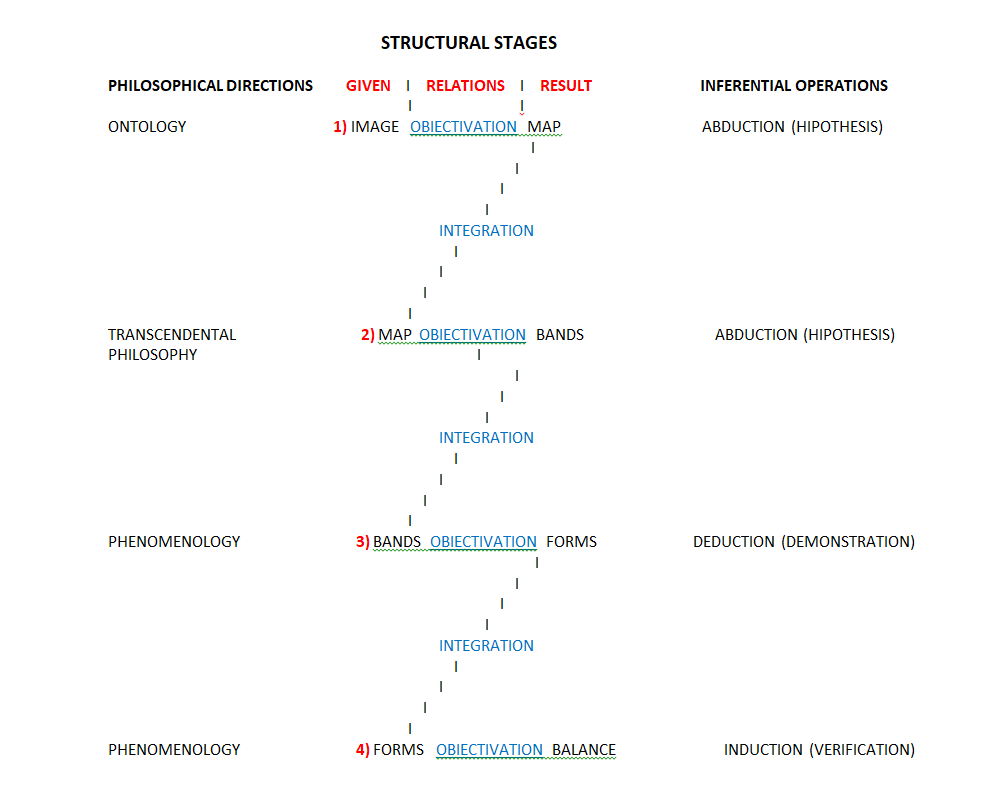
The research stages and their basic components will be presented below. Each structural stage consists of three fundamental components: the data of experience, the result of objectification, and the particularized relations established between them. The recursive character of the method means that the result of each stage becomes the data of experience for the following stage, thereby enabling the progressive and hierarchical development of the research. Furthermore, the structure of the research stages unfolds through a double analogy:
1) With the objective philosophical directions, whose purpose is to indicate the synthetic and essentializing—that is, abstracting—direction of the research;
2) With the inferential operations of logic developed by C. S. Peirce, which support the problematizing role of the research within the domain of pragmatics, distinct from the practical direction of Sergiu Celibidache’s phenomenological method.
The principle of intentionality, according to which every consciousness is consciousness of something, is adopted by Husserl (Husserl 1989, §§27–32, §§84–90) from the philosophy of Brentano (Brentano 2012, Book II, chap. 1) and becomes one of the foundations of phenomenology. Visual-artistic experience takes place within visual consciousness, but is impossible without a visual given. The entire process of exploring the structure of a work of visual art begins with the question: How do we relate to the work of visual art as a given? One of the fundamental methodological properties that we must recognize in the given of visual experience is its uniqueness. From a philosophical perspective, this uniqueness appears as substantial individuality in Aristotelian hylomorphism (Aristotle 2007, Metaphysics, Z (VII), 1–6, 7–12, 13–17; Aristotle 1938, Categories, chap. 5), as the singularity of the phenomenal object in intuition in Kant (Kant 1998, §1; §§1–8; A19/B33; A320/B377), or as the phenomenological identity of the object constituted in consciousness in Husserl (Husserl 1989, §§87–99, §§128–131).
In aesthetic experience, uniqueness is often interpreted axiomatically as a basis for the originality and value of the work of art, in the sense of subjective thinking (Croce 1956, 7; Pareyson 2022, 23). In objective thinking, however, the structural-methodological uniqueness of the work defines the given that initiates the research, not through its evaluation, but through placing the evaluation of the work in brackets. This does not mean that we deny the axiological function attributed to the uniqueness of the given of experience, but only that we suspend it methodologically in order to allow the transition from aesthetic experience to structural research. We do not eliminate the uniqueness of the work or the possibility of its aesthetic evaluation; rather, we change the orientation of the research: from the question of value to the question of the image constitution of the work. Instead of asking, How valuable is the work?; we ask: How is the image of the work perceptually and cognitively constituted?— as the given object of the unique visual experience underlying the structural research. From a methodological perspective, axiological evaluation is placed in brackets, without denying the uniqueness of the work, in order to allow the structural constitution of the unique image to be described by analogy with the way in which the objective philosophical directions conceive the constitution of the object.
Also, the unification of visual-field information through intentional-thematic processes of organizing spatial details, such as the recognition of externally viewed objects, is subjected to selective suspension (Purves et al. 2004; Grill-Spector and Malach 2004, 649–677; Biederman 1987, 115–147; Milner and Goodale 1995; Kanwisher 2010, 11163–11170; DiCarlo, Zoccolan, & Rust 2012, 415–434; Oliva and Torralba 2007, 520–527). This does not concern the suspension of their spatial representation, or of the properties and relations that it entails, but rather the interruption or attentional-selective ignoring of their subliminal, preconscious, and prereflexive signaling (Dehaene 2014; Dehaene and Changeux 2011; Lamme 2003, 12–18; Koch and Tsuchiya 2007, 16–22; Fuster 1995; Dehaene and Naccache 2001). By contrast, the recognition of natural scenes (Oliva and Torralba 2001, 145–175; Oliva and Torralba 2006, 23–36; Oliva and Torralba 2007, 520–527; Peelen, Fei-Fei, and Kastner 2009, 94–97), at the level of the spatial whole, may be indirectly involved in determining the morphological bands by directing attention toward relations of contiguity and symmetrization, without serving as a decisive factor in their topological delimitation.
How is the individualized image constituted, together with the results of objectification, and how are these subsequently integrated as the given of the research stages? To answer this question, we must first distinguish between two types of structural relations: the horizontal relation, constituted through objectification, and the diagonal relation, constituted through integration. While integration is a methodological relation, at the base of the recursive character of the research structure, objectification should be understood by analogy with the main philosophical directions of objective thinking: ontology, transcendental philosophy, and phenomenology—which historically derive from one another. An important observation is that the objectification of the unique image takes place before the actual methodological stages of the research, whereas the objectification of the results unfolds throughout the succession of the methodological stages of the research, as follows.
1) FROM THE INDIVIDUALIZED IMAGE TO THE MAP OF SURFACES
The first stage of the research aims to determine the relation between the individualized image and the map of surfaces, by analogy with ontological objectification. The ontological direction addresses the question: What is the object? (Aristotle 2007, Metaphysics, Γ 1, 1003a21–24). In the Aristotelian tradition, this question leads to an analysis of substance (ousia) (Aristotle 2007, Metaphysics, Ζ 1, Ζ 4), explained through the doctrine of hylomorphism. Aristotle maintains that the object, as an individual substance (ousia), is constituted by matter (hyle) and form (morphē/eidos), with form serving as the principle that determines and actualizes matter (Ainsworth 2024). The conceptual organization can be schematized as follows:
matter (hylē) + form (morphē/eidos) → individual substance (ousia)
Thus, in this stage, the individualized image fulfills the methodological function of the given of experience and can be regarded as the concrete material of the research (hylē). It can be defined as “this something” (tode ti), just as a particular horse is “this horse” (houtos ho hippos) or a particular human being is “this human being” (houtos ho anthrōpos), as Aristotle illustrates (Aristotle 1938, 1b6–9, 3b10–15). The image is not individualized because it is original in the axiological sense. Its individuality is related to the fact that its existence is determinate and concrete, rather than dependent on its value or exceptional character. By analogy with individual substance (ousia), the individualized image is “this image” (hautē hē eikōn), this concrete visual configuration of the work, regardless of whether or not the work is axiologically original. The individualization of the image is an ontological-methodological determination of the image as the concrete and material support given for research.
From the perspective of the relational component, the objectification of the map is understood, by analogy with the ontological model, as the differentiation, relationship and unification of chromatic and contour information, based on categorization models through which the visual configuration is determined in terms of its concrete topological and geometric components, forming a structural map. Although its development is guided by the toporetinal projections of the visual areas, the map of surfaces is not a neuronal representation of the image, but rather the result of a direct motor-bodily action involving the delimitation of contours and the filling of surfaces, performed on the physical reproduction by digital editing of the individualized image of the work, which serves as the basis for structural-visual research. This can be schematized as follows:
individualized image (concrete material basis) + formal modeling match → geometrically determined map of surfaces
Inferential operations are logical procedures through which already available structures are transformed into premises for problematization, allowing the research to move from these structures toward other structures, relations, or determinations that are to be formulated and evaluated within the successive stages of the method. From this perspective, the first stage of the research method proceeds on the basis of abduction, which contributes to the generation of a hypothesis as the first stage of scientific problematization. This involves a process of matching the image with categorical models of color and with models for orienting contour directions, corresponding by analogy to the inferential reference points indicated by Peirce:
“The mode of suggestion by which, in abduction, the facts suggest the hypothesis is by resemblance, — the resemblance of the facts to the consequences of the hypothesis.” (Peirce 1931–1958, CP 7.218)
Since the cited formulation refers to the scientific investigation of facts, the abductive function must here be transposed methodologically into the domain of visual experience within structural research, in which the individualized image constitutes the particular structure to which the categorization model is applied or within which it is identified. A schematic representation of the inferential operation at this hypothetical level of problematization could be formulated as follows:
individualized image + categorization model → abductive resemblance → hypothesis
2) FROM THE MAP OF SURFACES TO THE MORPHOLOGICAL BANDS
The second stage of structural research consists in the determination of the morphological bands through the intuitive ordering of the map of surfaces, which unfolds by analogy with transcendental philosophy. The transcendental direction addresses the question: How is experience of the object possible? (Kant 1998, A84–A130 / B116–B169; Kant 1998, A158/B197). It shifts the problem from the ontological constitution of the object to the conditions that make its experience possible. (Guyer 1987; Strawson 1966). In Kant, the object is initiated as a singular phenomenon through the sensory material given in intuition (Kant 1998, A19/B33; A68/B93–A69/B94), but becomes an object of experience only through the transcendental synthesis performed by the imagination and the categories of the understanding (Kant 1998, A78–A83 / B103–B109). This captures the central idea of the ”Critique of Pure Reason”: sensible material initiates the constitution of the phenomenon, but is not sufficient for the constitution of the object (Kant 1998, A20/B34–A21/B35; Kant 1998, A51/B75). The object of experience emerges only through the correlation of sensibility with the spontaneity of the understanding (Allison 1992, 381–403). The conceptual organization can be schematized as follows:
sensible material → phenomenon in the sensible intuition (space and time) → imagination synthesis → → categories application → the object of experience
From a transcendental perspective, the objectification of the morphological bands is considered by analogy with the conditions of possibility for the constitution of the object as a given of experience. At the neurocognitive level, these conditions match the organization of visual information into a unified visual field, projected and represented through retinotopic maps distributed across the cortical visual areas (Wandell and Winawer 2011, 718–737; Sedigh-Sarvestani et al. 2022, 1–16). This perspective is important for the method because it allows the map of surfaces, with its concrete geometric determination from the perspective of ontological objectification, to be integrated as a visual phenomenon and a given of experience. In this way, the map of surfaces constitutes the structural basis in relation to which the morphological bands can be determined as objects of visual experience.
Following the point of view of the relational component, the objectification of the morphological bands is understood, by analogy with the transcendental model, as the result of an imaginative synthesis achieved through the spatial intuition of the contiguity of contour directions and the symmetrization of the chromatic content of surfaces arranged along the direction of the band, in accordance with Gestalt principles. Thus, the transcendental model makes possible an analogy between philosophical conditionality and the conditions under which forms are determined through the delimitation of contiguous bands of morphological components (Wertheimer 2012, 127–182; Wagemans et al. 2012, 1172–1217, sec. 4.2.2; Field, Hayes, and Hess 1993, 173–193). This methodological procedure can be considered analogous to the collinearity effect in the cognitive domain, resulting from the processing of visual information in the primary visual cortex (V1) (Gilbert 1998, 467–485; Li and Gilbert 2002, 2846–2856; Wagemans et al. 2012, 1172–1217) and in subsequent visual networks. The structure of the objectification relation can be organized as follows:
map of surfaces (visual phenomenon & given of experience) → intuition of surface topology → relational synthesis through collinearity effect → morphological bands
Regarding the inferential operations, their character is abductive, as in the first stage. The difference lies in the perceptual nature of the matching process, which is based on Gestalt principles of organization and symmetrization, as well as in relating the map of surfaces to the cortical organization of visual information, which constitutes the structural premise for problematization in the determination of the morphological bands. The inferential operations are thus situated within the hypothetical domain of problematization in structural research.
3) FROM THE MORPHOLOGICAL BANDS TO THE VISUAL FORMS
The third stage of structural research consists in determining the visual forms and their components within the directional support provided by the morphological bands. The stage proceeds on the basis of the topology of the morphological bands consists of limits and intervals. Between the limits there are sizes; within the intervals there are colors. The separation of forms is achieved through successions of chromatically contrasting surfaces (D–L or L–D), in which each of the two chromatic intervals constitutes a potential morphological support. The concentration of forms is achieved through the arrangement of contrasts, symmetrized—that is, chromatically symmetrical, while allowing for asymmetry in the distances between intervals—in relation to the centered object (L–D–L or D–L–D), which is itself contrasted with the surrounding background regions. If two forms occur within the same band, L–D–L and D–L–D, they belong to the same iteration and develop in parallel. If we have L–D–L–D–L, we have a lower-order iteration form in which the object (D→D–L–D) has generated a new object, thereby becoming a higher-order iteration form. Variation in size between two background regions on either side of a centered object generates the directional sense of the object, from the larger, dominant background (the larger interval between limits) toward the smaller, recessive background (the smaller interval between limits), as determined through the quantitative comparison of distances.
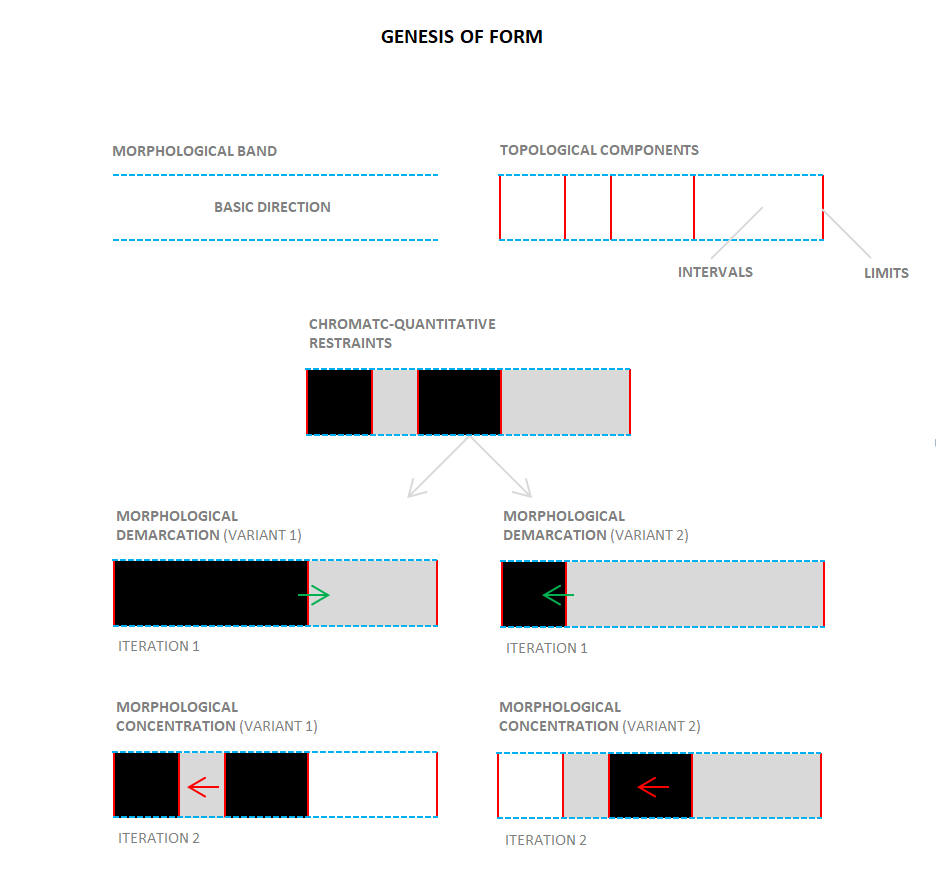
These structural relations facilitate an analogy with the methods of conceptual inquiry specific to phenomenological direction of objective thinking, which has its origins in Aristotelian hylomorphism. Phenomenology addresses the question: How is the object constituted in the experience of consciousness? (Zahavi 2003, 13–22; Husserl 1960, §§47–60; Husserl 1989, §§84–86, §§87–99, §§128–133). It takes up the Kantian problem about the conditions of possibility of experiencing the object and relocates it to the phenomenological descriptive domain of intentional consciousness (Zahavi 2003, 72–77). Husserl deepens the phenomenological genesis of the object within the flow of consciousness. He introduces a radical shift in the organization of our understanding of the object by redefining matter (hylē), which is no longer the matter of substance, as in Aristotle, nor the matter of sensible intuition, as in Kant, but rather the sensory content of lived experience (Husserl 1989, §§85–86, §§97–99; D. Smith 2013, chap. 6; A. Smith 2003). This reinterpretation also shifts the foundation of the object’s identity, which is no longer grounded in individual substance (ousia), as in Aristotle, nor in the mere intuitive givenness of the object, as in the Kantian account of singularity. For Husserl, the identity of the object is the result of constitutive syntheses carried out within the flow of consciousness, while intuition no longer simply finds the object but participates in its constitution (Husserl 1989, §§84–86, §§99–103; Husserl 1960, Meditation IV). This process can be schematized as follows:
↗ topological distinction
morphological bands → morphological model → selective attention → morphological
↘ topological unification object
Returning to the phenomenological schema of objectification, it should be noted that noesis (Husserl 1960, Meditation IV; Husserl 1989, §§84–88, §§89–99) designates the intentional act through which consciousness is directed toward an object in a particular manner—for example, through perception, imagination, judgment, or recollection. Noema (Husserl 1989, §§ 84–88, §§ 89–99; Drummond 2022, 144–146) designates the intentional object as constituted and intended in the act of consciousness—not the physical object as such, but the object as it is intended and given in the intentional act. Here, being directed toward refers to the manner in which consciousness intends something, an object in a particular mode (perceived, imagined, judged, or remembered). Noesis is the intentional act, analogous to the act of applying and instrumentalizing the morphological model, through which the model is identified by means of endogenous selective-attentional correlation (Poeppel, Mangun, and Gazzaniga 2020, chap. 62; Posner 1980, 3–25; Wolfe 2021, 713–734) in the act of morphological delimitation of the band’s surfaces. The noema, in turn, is the intended object, analogous to the form and its background components centered on either side of the morphological object. The determination of the morphological object within the visual form can be understood by analogy with eidetic reduction, through which, starting from the intentional object—the noematic pole—the determination of its essential structure is pursued. It should be specified here that the determination of the morphological object, as the structural essence of the form, is related to the topological context of the band, where color and size function as constraints in establishing the essentialization in an unequivocal manner, whereas in eidetic reduction, essentialization is achieved by isolating the invariant from a set of free variations in the properties of the object. On the basis of identifying the morphological object as the essential core of the visual form, the selective-attentional relations among its morphological components allow the determination of the object's vectorial sense. This sense is assigned through a selective-attentional comparison of size between the morphological background components of the visual form. At the neurocognitive level, it can be related to mechanisms of processing perceived implied motion, associated with activation of the cortical area V5 (Neri and Levi 2006; Tse and Albright 2005, 127–149; Zhaoping 2005, 143–153; Zhaoping 2019, 1–10). By analogy, vectorization can fulfill a function corresponding to noematic sense, expressing the determinate manner in which the noema, the intentional object, is given in correlation with the noesis, the intentional act. Noematic sense contributes to determining that “something” in the principle of intentionality—mentioned at the beginning—not as mere objectual existence, but through the determinate manner in which that “something” is given to consciousness as an intentional object.
The inferential operations within the third stage of the research have a deductive character, marking a shift in register as the problematization evolves from the hypothetical level to the demonstrative methodological level. The morphological band serves as the premise, understood as a topological and constructive support. Owing to certain properties and depending on specific criteria and principles of constraint, the surfaces, together with their topological components, can be reorganized into visual forms with their morphological components. As also found in the structural considerations of Henry Matisse (Matisse 1978), color and size, or quantity, are the principal properties contributing to the determination of this conversion, which also involves the delimitation of forms and their iterations. In general, morphology can be said to be generated, at its basis, from four possible minimal cases:
1) Chromatic symmetrization – quantitative asymmetrization;
2) Quantitative symmetrization – chromatic asymmetrization;
3) Chromatic-quantitative symmetrization (symmetry);
4) Chromatic-quantitative asymmetrization.
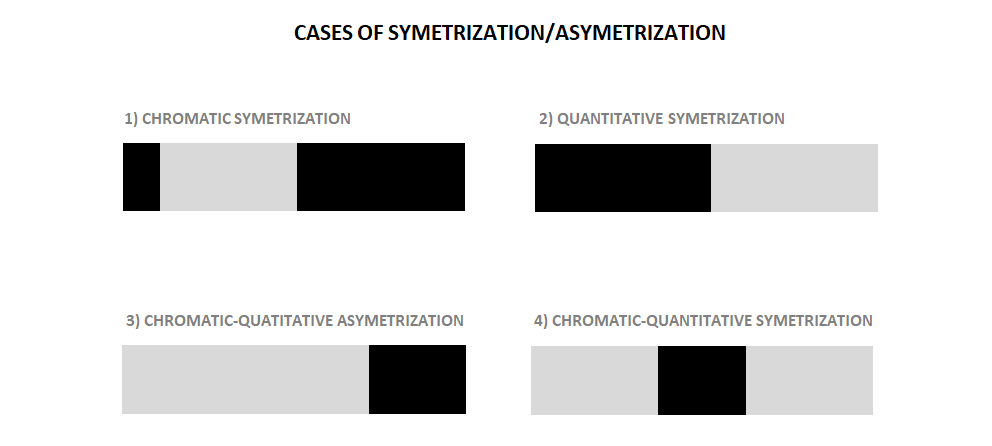
These are, however, only illustrative cases, obtained autonomously and independently of any applied material. In practice, the partitioning of a morphological band involves a method of chromatic-conventional marking of the topological-constructive limits, applied hierarchically and recursively from the margins toward the center of the band, as we will see in the chapter on properties.
I have introduced this methodological account in order to help us examine the operation of deduction in greater depth. Peirce formulates the function of deduction in relation to the hypothesis very clearly, following Kant’s model, which he nevertheless describes as a “half-truth” (Peirce 1931–1958, CP 7.204), because deduction can guarantee the logical consistency of the conclusion with the premises, but cannot guarantee that the premises are true in relation to experience:
«The entire meaning of a hypothesis lies in its conditional experiential predictions; if all its predictions are true, the hypothesis is wholly true.
This appears to be in harmony with Kant's view of deduction, namely, that it merely explicates what is implicitly asserted in the premises. This is what is called a half-truth.» (Peirce 1931–1958, CP 5.269–5.272)
He further maintains that, once a hypothesis has been adopted, the next step is to trace its necessary and probable experimental consequences. He explicitly distinguishes between necessary and probable deductions (Peirce 1931–1958, CP 4.233). Necessary deductions begin from premises accepted as true; consequently, the conclusion must invariably be true. Probable deductions have premises based on data that manifest themselves with a certain frequency, so that the conclusion is not presented as certain, but as true in the majority of cases over the long run. They therefore fall within the domain of scientific, experimental empiricism. Furthermore, within necessary deductions, Peirce distinguishes between corollarial and theorematic deduction (Peirce 1931–1958, CP 5.270). In theorematic deduction, the mere examination of the conditions contained in the premises, as in corollarial deduction, is insufficient; an “experiment” must be performed on the diagram. This procedure can be considered, by analogy, in relation to the application of the morphological model to the morphological bands, through which the structural relations leading to the conclusion are explored.
With regard to the structural process of morphological model-constraining, it can be related, by analogy, to the apodictic character of deductive argument, distinct from that of probability, as indicated by the following statements:
«A complete, simple, and valid argument, or syllogism, is either apodictic or probable.»
and:
«An apodictic or deductive syllogism is one whose validity depends unconditionally upon the relation of the fact inferred to the facts posited in the premises.» (Peirce 1931–1958, CP 5.270)
In apodictic deduction, the relation between the premises and the conclusion is unconditional. In other words, the premises determine the conclusion necessarily. By analogy, structural constraint can be understood as having a function corresponding to this unconditionality: once the structural- topological premises and the constraining criteria by color and size have been established, certain determinations of the form become necessary in relation to them.
4) FROM THE VISUAL FORMS TO COMPOSITIONAL BALANCE
Balance is the ultimate aim in structural research of visual works of art and the most complex notion that the researcher must investigate and understand. It has multiple, unexpected, and difficult-to-order modes of manifestation, both in relations to vectorial reduction proper within the morphological band and across the superposition of bands, and in relation to the unfolding of the preceding stages of structural research. Starting from the vectors assigned to morphological objects in the third stage, organized into basic dual combinations of vectors (→← convergent, ←→ divergent, ←← translational), we can develop or decompose a structurally indeterminate vectorial configuration. In principle, such a configuration can be composed with virtually unlimited freedom. Despite the exuberant possibilities of their development, these configurations can be progressively reduced to a single vector or to a state of morphological symmetry. To reach this level of maximum austerity in vectorial reduction the basic topological configurations are expressed morphologically: convergence becomes the dynamic object (→●←), or a stable-symmetric object (→X←); divergence becomes a demarcation (←│→); and modular translation becomes a background (←←/→→). On their basis, a synthetic vectorial configuration can be obtained, consisting of unitary zones that are static or dynamic, and symmetrical or asymmetrical. Their determination no longer derives from predetermined configurations, but from the emergence of symmetrical configurations in relation to asymmetrical ones, which mediate between them. In addition, a distinction must be made between stability (X) and dynamic modularity (→→→), since the repetition of a vector is not synonymous with the stabilization of the configuration.
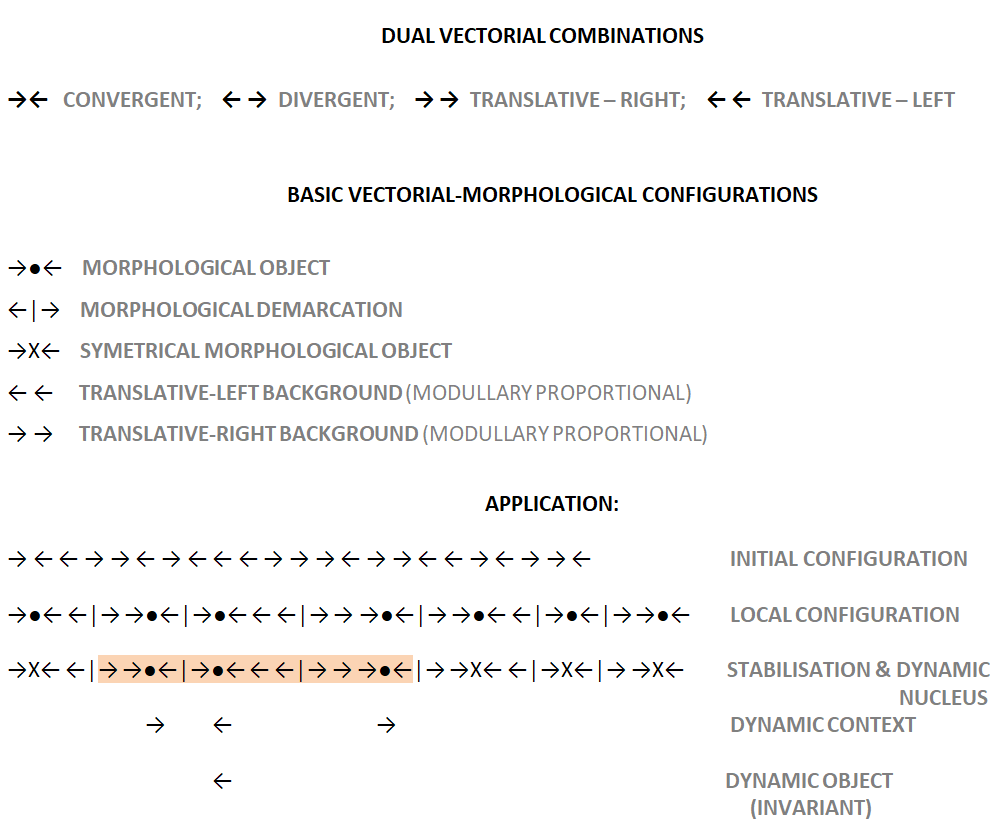
In conclusion, vectorial balance can be defined as the emergent structural state resulting from the successive reduction of an initial vectorial configuration, in which the local relations among vectors are organized as morphological components through correspondences, oppositions, and alternations within asymmetrical and symmetrical groupings, until a single vectorial-morphological configuration is stabilized, thereby concluding the synthesis and essentialization of the whole. This process can be schematized as follows:
vectors of morphological objects → initial vectorial configuration → identification of local relations → → local morphological classification → synthetic morphological stabilization → → invariant configuration (stable X, dynamic → / ←)
The relation of objectification specific to compositional balance is related to the essence of the visual form—the morphological object with its vectorial sense—as a given of visual experience (Husserl 1989, §§84–93). It provides the initial configuration for the process of vectorial reduction. Its structural and perceptual-cognitive development can be associated, by analogy, with the recurring phenomenological conceptual levels of intentionality, the noesis–noema correlation, and phenomenological synthesis, to which phenomenological reduction is added, associated with the final, synthetic and essentializing stages of structural-vectorial reduction (Peirce 1931–1958, CP 2.758–2.759), as shown in the following diagram:
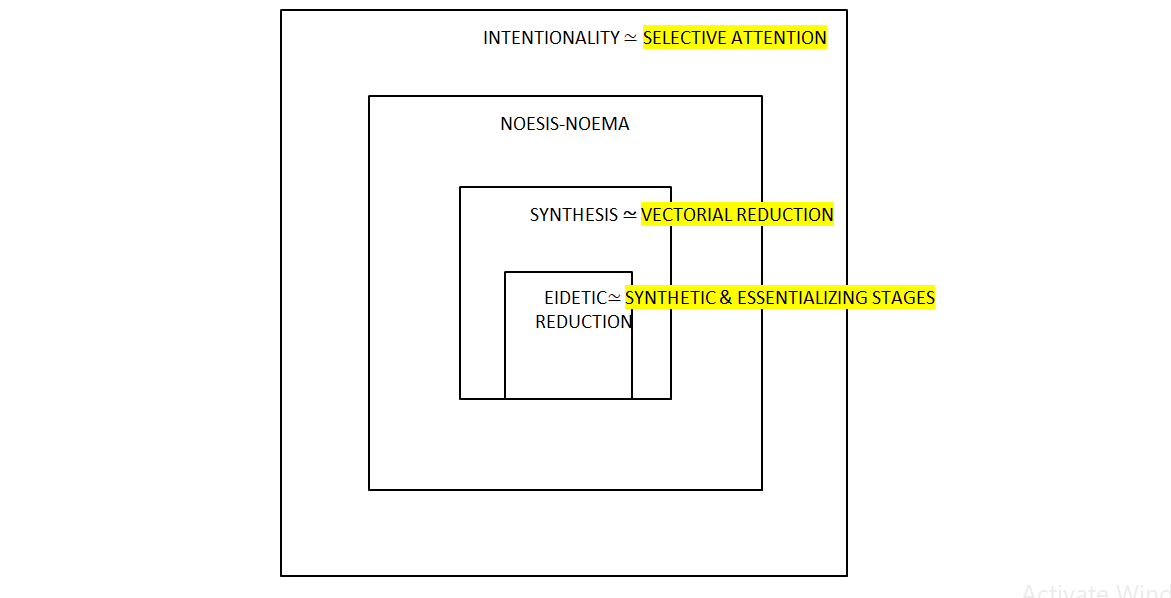
The principle of intentionality, according to which every consciousness is consciousness of something, discussed at the beginning, when I presented the schema underlying the stages of research, recurs here in the analogical-phenomenological contextualization of the development of vectorial reduction in compositional balancing at the level of the morphological band. Phenomenologically, intentionality is the correlational structure within which the relation between the act (noesis) and the intentional object (noema) arises (Husserl 1983, §§84–90). We do not consider selective attention to be the psychological equivalent of intentionality, but rather understand the two as standing in a functional-structural analogy. For Husserl, intentionality designates the fact that conscious experience is oriented toward something. Consciousness is not an indifferent state, but always has an object-directed orientation. Similarly, selective attention has an endogenous structure oriented toward certain information, properties, or relations within a model proposed for instrumentalization, while other information remains in the background. However, not all intentional acts are acts of selective attention (Husserl 1960, §18). For example, I may perceive, remember, imagine, or judge something without explicitly attending to it. All of these acts are intentional, but not all can be reduced to attention. Therefore, selective attention can be considered the functional analogue of intentional orientation only within the domain of selective perceptual and cognitive processing (Husserl 1960, §§17–18). Nevertheless, certain common properties can be identified between intentionality and selective attention, such as directionality, which implies that both are oriented toward something; selectivity, which implies that this orientation does not treat all features of the field as equivalent; and objectification or targeting, through which the orientation entails that certain features function as the object or target of processing. Selective attention can also have successive objects, both from one stage of the research to another and within the succession of configurations unfolding throughout the structural reduction of vectorial balance. In this sense, selective attention enables the instrumentalization of the morphological model at the level of vectorial configurations. By phenomenological analogy, the intentional pole toward which consciousness is oriented can, in a subsequent experience, become the point of departure for a new intentional orientation, in accordance with the recursive character of vectorial reduction.
Beyond the instrumental identification of the morphological model in the development of the reductive vectorial configurations, selective attention distinguishes between variation and the stabilizing identity of vectorial configurations. Phenomenologically, this is analogous to the way in which the relation between noesis and noema is constituted within intentionality (Husserl 1983, §§84–90; Husserl 1960, §§17–18). For example, if I perceive an initial topological-vectorial configuration, the noesis corresponds to my act of perceiving the configuration (Husserl 1960, §18), whereas the noema corresponds to the configuration of the object as intended and given in the perceptual act, while the intended object transcends each of its particular appearances. For Husserl, “transcendent” does not necessarily mean “supersensible” or “metaphysical” (Husserl 1983, §§31–33). First and foremost, it means what is not actually contained within the conscious experience. For example, I perceive a cube. At a given moment, I see only certain faces of it (Husserl 1983, §§3–4, §70). Nevertheless, I intend it as one and the same cube, with faces that I do not currently see and that may become visible if I change my position. Thus, the transcendent object is intended as one and the same object beyond each of its particular appearances, whereas the noema is the object as intended within this particular configuration of experience. The same applies to the perception of a vectorial configuration: its identity is established beyond the different forms that result by grouping of vectors according to the morphological model, through the identification of their basic dynamic and static vectorial state, which lead to a final stabilization, whether dynamic or symmetrical, that structurally transcends all preceding configurations. This brings us to the next notion: phenomenological synthesis.
In phenomenological analysis, synthesis serves to explain how a multiplicity of appearances is articulated into the unity of an object (Husserl 1983, §70). It is not a stage that simply follows the manifestation of appearances, but the process through which their multiplicity is organized into a unity. At the structural level, it does not have as its analogue any particular stage in the reduction of vectorial configurations, but rather the entire recursive process of vectorial balancing, according to the following scheme:
multiplicity of appearances → phenomenological synthesis → unity of the object
which, by analogy, corresponds to:
multiplicity of vectors → morphological reconfigurations + synthetic reductions → invariant configuration
Synthesis is largely pre-reflective. It belongs to the structure that constitutes the experience. Consciousness does not first encounter completely independent fragments and then decide to unite them (Husserl 1973, §36; Husserl 2001, 57). The unity of the object is constituted through the very unfolding of intentional experience. Intentionality is the general structure through which consciousness is oriented toward something. Within this structure, we have noesis—the intentional act—and noema—the object as intended, or the objectual sense—where synthesis is the process through which the multiplicity of appearances is articulated into a unity corresponding to the noema, which is also the objectual pole (Belt 2022, 405–434). Thus, intentionality is the structure of orientation; the noesis–noema correlation is the structure of the act–intentional object relation; and synthesis is the manner in which, within this correlation, the multiplicity of appearances is unified.
The transcendent aspect of the noema also requires further examination. Here, “transcendent” does not mean that the noema enters into synthesis as a “state outside consciousness” that would unify the appearances; rather, it means that the noema, as the intentional object, is not exhausted by any one of its appearances and remains as the identity of the object. Synthesis unifies them because they are all given as appearances of one and the same object. The intentional object is more than each of the particular modes in which it presents itself (Husserl 1983, §§88–90, §131). Therefore, transcendence is not “something added” to synthesis, but rather the structure whereby each particular appearance is surpassed by the identical object intended, as shown in the following scheme:
multiplicity of appearances → intentional synthesis → identity of the object → transcendence of the object
An analogy is thus established between the phenomenological object, which transcends each appearance, and the invariant resulting from the reduction of vectorial configurations, which structurally transcends each of the particular synthetic configurations, as the final pivot of vectorial balancing.
To clarify how the invariant of vectorial balancing is determined, we can compare the final stages of structural reduction with Husserl’s method of eidetic reduction. The two methods differ in their procedures, but they share a methodological concern: determining what remains invariant under variation. In Husserl’s eidetic reduction, an exemplar or an intentional formation is given and subjected to imaginative variation (Husserl 1983, §70). By analogy, in the vectorial balancing model, the final stages of structural reduction operate not on the initial vectorial given, resulting from the third stage of analysis, but on vectorial balancing configurations that have already been synthesized and stabilized. In eidetic variation, the determinations of an object are imaginatively modified to establish which can change and which must remain unchanged for the object to retain its eidetic identity (Husserl 1983, §§70–75; De Santis 2011). The guiding question is: What is necessary for a thing to remain what it is? By distinguishing variable determinations from those necessary to the object’s identity, eidetic variation makes it possible to identify the invariant structure (Belt 2022). It is one of the principal procedures through which eidetic reduction is carried out. The analogy between eidetic variation and vectorial balancing lies in their shared concern with invariance, although they serve to identify it through different procedures. In Husserl’s phenomenology, eidetic variation involves imaginatively modifying an intentional object to determine which of its essential characteristics remain invariant across possible variations. In the present method, structural reduction serves to identify a comparable aim by successively grouping morphological configurations and reassessing their vectorial orientations, thereby identifying the invariant relational structure underlying vectorial balance. The analogy concerns the search for invariance, not an equivalence between the two procedures. The two procedures can therefore be compared in terms of their shared aim of determining invariance, without equating their respective operations. We can schematize the process as follows:
individual object → eidetic variation → elimination of the accidental → invariant → eidos
Thus, eidetic reduction is not identical with eidetic variation (Husserl 1983, §§70–75; De Santis 2011). Within the orientation toward the essence or invariant of the object, eidetic variation is the procedure through which the determinations of the object are modified in order to arrive at its essence, that is, at what is determined as its necessary structure. By analogy, at the structural level, we can ask: What is necessary to preserve the symmetrical and stable, or asymmetrical and dynamic, character of the result of the vectorial reduction of balancing? In the first case, what determines symmetry is the symmetry of all the forms that precede essentialization. In the second case, what determines the dynamism of the object is the variation in distance produced by the translational-vectorial modularity of the backgrounds that flank it. Thus, we have the following schemes:
dynamic configuration → modular-translational variations of the backgrounds → quantitative comparison → elimination of non-essential variations → determination of the necessary relation defining the object's sense
and:
static configuration → modular-translational invariances (equalities) of the backgrounds → quantitative comparison → elimination of non-essential variations → determination of the necessary relation defining the object's invariance
Transcendence explains why the object is not exhausted by any particular appearance, whereas eidetic variation more directly explains how what is invariant can be determined by modifying particular determinations. Therefore, the analogy with eidetic variation implies that, in the process of balancing, we do not seek to obtain what remains visually identical from one vectorial configuration to another, but rather which structural relations must remain invariant to preserve vectorial identity across successive stages of reduction, in both dynamic and static configurations.
Within the inferential operations, the entire process of balancing can be considered by analogy with the operation of inductive thinking (Peirce 1931–1958, CP 2.759). In the present analogy, the properties of the inductive process can be related to different properties of the reductive development of the vectorial configurations involved in compositional balancing. These evolve from an indeterminate vectorial multiplicity, which constitutes the premise to the morphological configuration that results through the local instrumentalization of the morphological model, and then to the synthesis of static and dynamic configurations, obtained by grouping local morphological configurations and reducing them to the vectorial tendencies of their objects, followed by their vectorial essentialization.
The inductive function that Peirce describes as qualitative (Peirce 1931–1958, CP 2.758–2.759) presents an analogy with the vectorial reduction of compositional structural balancing. Unlike quantitative induction, which is based on measurement and statistics, qualitative induction evaluates relations according to the structural-visual relevance of the cases. Peirce states that:
«It consists of those inductions which are neither founded upon experience in one mass, as Crude Induction is, nor upon a collection of numerable instances of equal evidential values, but upon a stream of experience in which the relative evidential values of different parts of it have to be estimated according to our sense of the impressions they make upon us.» (Peirce 1931–1958, CP 2.759)
In other words, qualitative induction is based on a stream of experience whose parts do not have the same evidential value. The researcher must estimate the relative value of the different parts of experience according to the relations to which they induce within the morphological structure already generated demonstratively, in order to stabilize its vectorial regularities.
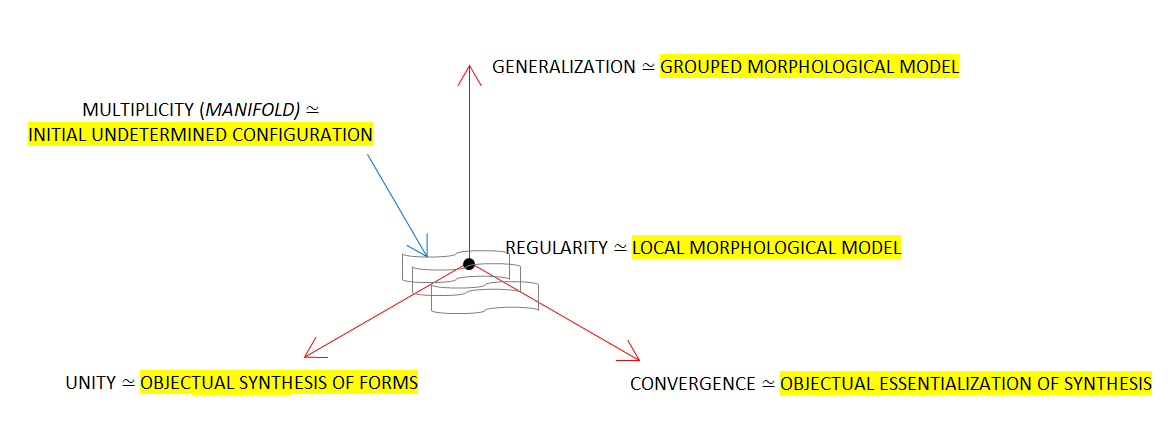
Given the vectorial multiplicity of the initial configuration proposed for structural reduction, its reorganization into increasingly comprehensive relational units, initially entails the local application of the morphological model to dual and consecutive groupings of vectors. This yields forms with morphologically expressed vectorial components. From the objects of these vectorial forms, predetermined in the previous stage of balancing reduction, a new vectorial configuration is extracted, which displays morphological configurations with a dynamic state when the translational vectors are distributed in unequal numbers on either side of the objects; or morphological configurations with a stable state when the translational vectors are distributed in equal numbers on either side of the objects. Following the morphological grouping of configurations of stable and dynamic objects, synthetic configurations result, which can then be reduced to a single state, either dynamic or stable, that establishes the essentialization and invariant of the reduction. In this context, we must identify the analogy between the stages of the reductive structure of balance and the characteristics of qualitative induction—that is, regularity, generalization, unity, and convergence—as shown in the following diagram:
For Peirce, manifold denotes a multiplicity of distinct impressions, cases, or logical subjects (Peirce 1931–1958, CP 1.545–1.546, 1.554), whose diversity has not yet been organized into a determinate unity and which, precisely by virtue of this multiplicity, calls for an operation of differentiation, comparison, and unification. Peirce states that:
«But since there is a manifold of impressions, we have a feeling of complication or confusion, which leads us to differentiate this impression from that, and then, having been differentiated, they require to be brought to unity.»
and continues with:
«Now they are not brought to unity until we conceive them together as being ours, that is, until we refer them to a conception as their interpretant.» (Peirce 1931–1958, CP 1.554)
Thus, the manifold is a plurality of distinct, as yet unified impressions, but not a mere random collection. It produces a feeling of confusion, yet through differentiation its unification becomes possible. The obstacle to unification is diversity, as Peirce specifies in the same text:
«[...]that is clearly the diversity of impressions. If we had but one impression, it would not require to be reduced to unity [...]»(Peirce 1931–1958, CP 1.554)
In this way, at the inferential level, we can see the analogue of the initial and indeterminate configuration of vectors in the manifold, which constitutes the initial given of vectorial balancing reduction. Nevertheless, following the analogy with Peirce’s conception, each new resulting configuration can itself be considered an indeterminate manifold for a new stage of the reduction. In fact, each new configuration is composed of the states of the objects from the preceding stages, upon which the vectorial morphological model is applied once again. In this sense, Peirce states:
«[...] one such conception may unite the manifold of sense and yet another may be required to unite the conception and the manifold to which it is applied; and so on.» (Peirce 1931–1958, CP 1.546)
In the present methodology, the starting point for the analogy with induction is the regularity identified within the manifold of configurations. The application, or instrumentalization, of the morphological model to the indeterminate configuration has its analogue in this inductive property at the inferential level. Regularity is the recurrent inferential relation that is structurally and analogically present in the configurations resulting from the application of the morphological model (Peirce 1931–1958, CP 2.759, 5.170). It plays a central role in describing the characteristics of qualitative induction, which do not follow one another linearly as successive stages, but rather manifest themselves as different ways in which the same regularity is determined, extended, organized, and pursued in the inductive process. Regularity answers the question: What is repeated? Whereas generalization answers the question: In what other configurations does the same relation persist? Like regularity, but at the structural level, the morphological model is repeatedly applied from one stage to another, recursively. First, the morphological model is applied to the initial indeterminate configuration at the local vectorial level, with the generalization of regularity as its inferential analogue. It is then found at the level of synthetic vectorial grouping, where the vectorial morphologization has inferential unity as its analogue. Finally, it can be identified at the ultimate reductive level, where the invariant and essentialized morphological object has the convergence of regularity as its inferential analogue.
Generalization concerns extending the domain in which regularity applies (Peirce 1931–1958, CP 5.276). It does not correspond to a single reductive stage, but is specific to the extension of the same regularity from one stage of the recursive reduction to another, as the results of vectorial morphologization become new initial configurations. It answers the question: How far does the same regularity persist? The extension of the morphological model from the dual level of the initial indeterminate configuration to the resulting objects, and its continued application throughout the vectorial reduction, has its inferential analogue in generalization. The regularity observed between the initial vectors can be identified among the objects resulting from their combination, and then among the objects observed following the grouping of these objects. Thus, the same regularity acquires higher-order, generalized validity. It also supports the analogy between the structural stages of the vectorial reduction and the prospective character of the inferential process, insofar as the result of one stage determines the next reductive step, while in inferential perspective the prospective character lies in the fact that the results obtained at a given point in the research guide subsequent inferences and open up possibilities for further development, verification, or revision.
Unity answers the question: How constitutes what is repeated? It establishes the connection between regularity and its structural constitution and It is the result of the organization of the manifold, rather than a mere property parallel to regularity and generalization (Peirce 1931–1958, CP 1.545–1.546, 1.554). Peirce states that:
«But since there is a manifold of impressions, we have a feeling of complication or confusion, which leads us to differentiate this impression from that, and then, having been differentiated, they require to be brought to unity.» (Peirce 1931–1958, CP 1.554)
And he further specifies:
«For one such conception may unite the manifold of sense and yet another may be required to unite the conception and the manifold to which it is applied; and so on.» (Peirce 1931–1958, CP 1.546)
If the regularity of the qualitative-inductive operation corresponds, by analogy, to the morphologization of vectorial configurations, unity shows us how that regularity is organized in structural terms. It is analogous to the fact that certain morphologized vectorial groupings are associated with certain morphological components, which contribute to the determination of objects as the basis of higher-order configurations. Thus, a hierarchically unified progression is formed:
vectors → morphological objects → new manifold of objects → higher-order objects → ...
with the following analogy at the inferential level:
manifold → conception/unification → new higher-order manifold → another conception/unification → ...
Convergence does not say what is repeated or where it is applied, but rather how the manifold of determinations evolves in the inductive process toward an increasingly restricted structural determination, culminating in the invariant. It answers the question: To what extent does regularity lead toward an increasingly restricted determination? Convergence’s structural analogue is the reductive procedure of balancing vectorial configurations through synthesis and final essentialization. The process thus reaches the limit of reductive determinations. Synthetic configurations result in invariant stable or dynamic vectorial states. In the structural method of balancing, the outcome of convergence corresponds to the limit of structural reduction, which is the final vectorial invariant. It answers the question: What remains once the relevant variations have been eliminated? It consists in what is obtained through relevant variations and reductions. Reference to the invariant result, as well as to the reductive stages, may lead to modifications of earlier structural stages of the research, with the aim of achieving greater reductive clarity at the balancing stage. At the inferential level of induction, this corresponds to the self-corrective character of the process through the confirmation, modification, or abandonment of structural decisions made in previous stages of the research (Peirce 1931–1958, CP 5.170, 7.114–7.120; Peirce 1931–1958, CP 2.759, 7.114–7.120).
In conclusion, the manifold is the starting condition; regularity is the relation identified within the manifold; generalization extends the domain of this relation; unity organizes it into a determinate configuration; convergence drives the reduction toward an increasingly restricted determination; and the invariant is the structural limit of this reduction. Recursivity is the mechanism that allows the unity obtained at one level to become a manifold for the next level.
Although it is a complex and arduous undertaking, mapping the modes of thought involved in the research method is entirely necessary for understanding the functionality of the research stages, both from the philosophical perspective of structural abstraction and essentialization and from that of inferential-pragmatic problematization. All of this is also necessary for the development of the research itself, within which we must know where and how future mathematical formalizations are to be developed and applied, with deductive and inductive—synthetic and essentializing—characteristics, on the basis of the preparatory, abductive stages, which have an intuitive character. In the following two parts of this exposition, I will continue with the mathematical formulation of the result of morphological objectification, followed by its applications. We will see how programming and graphic editing enable the implementation of the morphological model through application scripts, its expression and mathematical-topological demonstration through set-theoretic language and synthetic geometry, as well as the expression of compositional balance through binary language within information theory. Thus, the objective basis necessary for the replication and further investigation of visual-compositional structure is established.
REFERENCES :
Ainsworth, Thomas. 2024. “Form vs. Matter.” The Stanford Encyclopedia of Philosophy. Fall 2024 Edition. Edited by Edward N. Zalta and Uri Nodelman. Metaphysics Research Lab, Stanford University. https://plato.stanford.edu/archives/fall2024/entries/form-matter/.
Allison, Henry E. 2006. “Kant on Freedom of the Will.” In The Cambridge Companion to Kant and Modern Philosophy, edited by Paul Guyer, 381–415. Cambridge: Cambridge University Press. https://doi.org/10.1017/CCOL052182303X.012.
Apostolescu, Iulian, and Claudia Serban, eds. *Husserl, Kant and Transcendental Phenomenology*. Berlin and Boston: De Gruyter, 2020. https://doi.org/10.1515/9783110564280.
Aristotle. 1938. Categories. On Interpretation. Prior Analytics. Translated by H. P. Cooke and Hugh Tredennick. Loeb Classical Library 325. Cambridge, MA: Harvard University Press.
Aristotle. 1960. Posterior Analytics. Translated by Hugh Tredennick and E. S. Forster. Cambridge, MA: Harvard University Press.
Aristotle. 2007. Aristotle’s Metaphysics. United Kingdom: Read Books.
Belt, Jaakko. 2022. “Eidetic Variation: A Self-Correcting and Integrative Account.” Axiomathes 32: 405–434. https://doi.org/10.1007/s10516-021-09611-1.
Biederman, Irving. 1987. “Recognition-by-Components: A Theory of Human Image Understanding.” Psychological Review 94 (2): 115–147. https://doi.org/10.1037/0033-295X.94.2.115.
Brentano, Franz. 2012. Psychology from an Empirical Standpoint. Taylor & Francis.
Copleston, Frederick. 2003. A History of Philosophy, Volume 1: Greece and Rome. United Kingdom: Bloomsbury Academic.
Copleston, Frederick. History of Philosophy Volume 5: British Philosophy: Hobbes to Hume. United Kingdom: Bloomsbury USA, 2023.
Copleston, Frederick. 2023. A History of Philosophy, Volume 6: The Enlightenment: Voltaire to Kant. United Kingdom: Bloomsbury USA.
Coward, Harold, and Toby Foshay, eds. 1992. Derrida and Negative Theology. With a conclusion by Jacques Derrida. Albany: State University of New York Press.
Croce, Benedetto. 1956. Aesthetic: As Science of Expression and General Linguistic. Translated by Douglas Ainslie. New York: Noonday Press.
Daston, Lorraine, and Peter Galison. 2007. Objectivity. New York: Zone Books.
de Boer, Karin. *Kant’s Reform of Metaphysics: The Critique of Pure Reason Reconsidered*. Cambridge: Cambridge University Press, 2020. https://doi.org/10.1017/9781108897983.
Dehaene, Stanislas, and Lionel Naccache. 2001. “Towards a Cognitive Neuroscience of Consciousness.” Cognition 79 (1–2): 1–37. https://doi.org/10.1016/S0010-0277(00)00123-2.
Dehaene, Stanislas. 2014. Consciousness and the Brain: Deciphering How the Brain Codes Our Thoughts. New York: Viking.
Delacroix, Eugène. 1948. The Journal of Eugène Delacroix. Translated by Walter Pach. New York: Crown Publishers.
De Santis, Daniele. 2011. “On Husserlian Eidetic Variation and Its Duplicity: ‘Contingency-Variation’ or ‘Similarity-Variation’?” Alter: Revue de phénoménologie 19: 65–81. https://doi.org/10.4000/alter.1369
Descartes, René. 1990. Meditationes de prima philosophia / Meditations on First Philosophy. Bilingual edition. Introduced, edited, translated, and indexed by George Heffernan. Notre Dame, IN: University of Notre Dame Press.
DiCarlo, James J., Davide Zoccolan, and Nicole C. Rust. 2012. “How Does the Brain Solve Visual Object Recognition?” Neuron 73 (3): 415–434. https://doi.org/10.1016/j.neuron.2012.01.010
Drummond, John J. 2022. Historical Dictionary of Husserl’s Philosophy. 2nd ed. Lanham, MD: Rowman & Littlefield.
Field, David J., Anthony Hayes, and Robert F. Hess. 1993. “Contour Integration by the Human Visual System: Evidence for a Local ‘Association Field.’” Vision Research 33 (2): 173–193. ScienceDirect.
Flonta, Mircea. 2024. Fascinația absolutului: Filozofia speculativă în viziunea lui Lucian Blaga și Constantin Noica. Edited by Grigore Vida. București: Humanitas.
Fuster, Joaquin M. 1995. Memory in the Cerebral Cortex: An Empirical Approach to Neural Networks in the Human and Nonhuman Primate. Cambridge, MA: MIT Press.
Gilbert, Charles D. 1998. “Adult Cortical Dynamics.” Physiological Reviews 78 (2): 467–485. https://doi.org/10.1152/physrev.1998.78.2.467.
Grill-Spector, Kalanit, and Rafael Malach. 2004. “The Human Visual Cortex.” Annual Review of Neuroscience 27: 649–677.
Guyer, Paul. 1987. Kant and the Claims of Knowledge. Cambridge: Cambridge University Press.
Husserl, Edmund. 1960. Cartesian Meditations: An Introduction to Phenomenology. Translated by Dorion Cairns. The Hague: Martinus Nijhoff.
Husserl, Edmund. 1973. Experience and Judgment: Investigations in a Genealogy of Logic. Edited by Ludwig Landgrebe. Translated by James S. Churchill and Karl Ameriks. Evanston, IL: Northwestern University Press.
Husserl, Edmund. 1983. Ideas Pertaining to a Pure Phenomenology and to a Phenomenological Philosophy: First Book: General Introduction to a Pure Phenomenology. Translated by Fred Kersten. The Hague: Martinus Nijhoff.
Husserl, Edmund. 1989. Ideas Pertaining to a Pure Phenomenology and to a Phenomenological Philosophy: Second Book: Studies in the Phenomenology of Constitution. Translated by Richard Rojcewicz and André Schuwer. Dordrecht: Kluwer Academic Publishers.
Husserl, Edmund. 2001. Analyses Concerning Passive and Active Synthesis: Lectures on Transcendental Logic. Translated by Anthony J. Steinbock. Dordrecht: Kluwer Academic Publishers.
Kandinsky, Wassily. 1946. On the Spiritual in Art. Edited by Hilla Rebay. New York: Solomon R. Guggenheim Foundation for the Museum of Non-Objective Painting.
Kandinsky, Wassily. 1947. Point and Line to Plane. New York: Solomon R. Guggenheim Foundation.
Kant, Immanuel. 1998. Critique of Pure Reason. Edited and translated by Paul Guyer and Allen W. Wood. The Cambridge Edition of the Works of Immanuel Kant. Cambridge: Cambridge University Press.
Kanwisher, Nancy. 2010. “Functional Specificity in the Human Brain: A Window into the Functional Architecture of the Mind.” Proceedings of the National Academy of Sciences 107 (25): 11163–11170. https://doi.org/10.1073/pnas.1001296107.
Koch, Christof, and Naotsugu Tsuchiya. 2007. “Attention and Consciousness: Two Distinct Brain Processes.” Trends in Cognitive Sciences 11 (1): 16–22. https://doi.org/10.1016/j.tics.2006.10.012.
Lamme, Victor A. F. 2003. “Why Visual Attention and Awareness Are Different.” Trends in Cognitive Sciences 7 (1): 12–18. https://doi.org/10.1016/S1364-6613(02)00013-X.
Li, Wu, and Charles D. Gilbert. 2002. “Global Contour Saliency and Local Collinear Interactions.” Journal of Neurophysiology 88 (5): 2846–2856. https://doi.org/10.1152/jn.00982.2001.
Matisse, Henri. 1978. Matisse on Art. Edited by Jack D. Flam. New York: E. P. Dutton.
Milner, A. David, and Melvyn A. Goodale. 1995. The Visual Brain in Action. Oxford Psychology Series 27. Oxford: Oxford University Press.
Mondrian, Piet. 1986. The New Art—The New Life: The Collected Writings of Piet Mondrian. Edited and translated by Harry Holtzman and Martin S. James. Boston: G. K. Hall & Co.
National Academies of Sciences, Engineering, and Medicine. 2019. Reproducibility and Replicability in Science. Washington, DC: The National Academies Press. https://doi.org/10.17226/25303.
Neri, Peter, and Dennis M. Levi. 2006. “Spatial Resolution for Object Boundaries, Contours and Surfaces from the Early Visual Cortex.” Journal of Vision 6 (12): 54. https://doi.org/10.1167/6.12.54.
Oliva, Aude, and Antonio Torralba. 2001. “Modeling the Shape of the Scene: A Holistic Representation of the Spatial Envelope.” International Journal of Computer Vision 42 (3): 145–175. https://doi.org/10.1023/A:1012495526105.
Oliva, Aude, and Antonio Torralba. 2006. “Building the Gist of a Scene: The Role of Global Image Features in Recognition.” In Visual Perception, edited by Stephen Sussex, 23–36. Progress in Brain Research 155. Amsterdam: Elsevier. https://doi.org/10.1016/S0079-6123(06)55002-2.
Oliva, Aude, and Antonio Torralba. 2007. “The Role of Context in Object Recognition.” Trends in Cognitive Sciences 11 (12): 520–527. https://doi.org/10.1016/j.tics.2007.09.009
Pareyson, Luigi. 2022. “Estetica. Teoria della formatività. Preface to the 1988 Edition, Followed by ‘The Specification of Art.’” 23–40. https://doi.org/10.1515/9783035622447-002.
Peelen, Marius V., Li Fei-Fei, and Sabine Kastner. 2009. “Neural Mechanisms of Rapid Natural Scene Categorization in Human Visual Cortex.” Nature 460 (7251): 94–97. https://doi.org/10.1038/nature08103.
Poeppel, David, George R. Mangun, and Michael S. Gazzaniga, eds. 2020. The Cognitive Neurosciences. 6th ed. Cambridge, MA: MIT Press.
Peirce, Charles S. 1931–1958. Collected Papers of Charles Sanders Peirce. Edited by Charles Hartshorne, Paul Weiss, and Arthur W. Burks. 8 vols. Cambridge, MA: Harvard University Press.
Posner, Michael I. 1980. “Orienting of Attention.” The Quarterly Journal of Experimental Psychology 32 (1): 3–25. https://doi.org/10.1080/00335558008248231.
Purves, Dale, George J. Augustine, David Fitzpatrick, William C. Hall, Anthony-Samuel LaMantia, James O. McNamara, and S. Mark Williams. 2004. Neuroscience. 3rd ed. Sunderland, MA: Sinauer Associates.
Schmidt-Garre, Jan, dir. 1992. Celibidache: Man will nichts – man lässt es entstehen. Munich: PARS Media.
Sedigh-Sarvestani, Madineh, Ian P. Howard, Willem I. A. Groen, Daniel J. Kravitz, and David Fitzpatrick. 2022. “What and Where: Location-Dependent Feature Sensitivity as a Canonical Organizing Principle of the Visual System.” Frontiers in Neural Circuits 16: 1–16. https://doi.org/10.3389/fncir.2022.834876.
Smith, A. D. 2003. Routledge Philosophy GuideBook to Husserl and the Cartesian Meditations. London: Routledge.
Smith, David Woodruff. 2013. Husserl. 2nd ed. London: Routledge.
Strawson, P. F. 1966. The Bounds of Sense: An Essay on Kant’s Critique of Pure Reason. London: Methuen.
Tse, Peter U., and Thomas D. Albright. 2005. “The Role of V1 in Contour Integration and Perceptual Organization.” In The Primary Visual Cortex, edited by Boyd R. Kottalam, 127–149. New York: Nova Science Publishers.
Wagemans, Johan, James H. Elder, Michael Kubovy, Stephen E. Palmer, Mary A. Peterson, Manish Singh, and Rüdiger von der Heydt. 2012. “A Century of Gestalt Psychology in Visual Perception: I. Perceptual Grouping and Figure–Ground Organization.” Psychological Bulletin 138 (6): 1172–1217. https://doi.org/10.1037/a0029333.
Wandell, Brian A., and Jonathan Winawer. 2011. “Imaging Retinotopic Maps in the Human Brain.” Vision Research 51 (7): 718–737. https://doi.org/10.1016/j.visres.2010.08.015.
Wertheimer, Max. 2012. “Investigations on Gestalt Principles.” In On Perceived Motion and Figural Organization, edited by Lothar Spillmann, 127–182. Cambridge, MA: MIT Press.
Wolfe, Jeremy M. 2021. “Guided Search 6.0: An Updated Model of Visual Search.” Psychonomic Bulletin & Review 28 (3): 713–734. https://doi.org/10.3758/s13423-020-01859-9.
Zahavi, Dan. 2003. Husserl’s Phenomenology. Stanford, CA: Stanford University Press.
Zelle, Tom. 1996. “Sergiu Celibidache: Analytical Approaches to His Teachings on Phenomenology and Music.” PhD diss., Arizona State University.
Zhaoping, Li. 2005. “Border Ownership from Intracortical Interactions in Visual Area V2.” Neuron 47 (1): 143–153. https://doi.org/10.1016/j.neuron.2005.05.032.
Zhaoping, Li. 2019. “A New Framework for Understanding Vision from the Perspective of the Primary Visual Cortex.” Current Opinion in Neurobiology 58: 1–10. https://doi.org/10.1016/j.conb.2019.06.001.